Vacation Rental Near Mexico City for a Stress-Free Long Weekend
A vacation rental near Mexico City is the most practical...
Read more



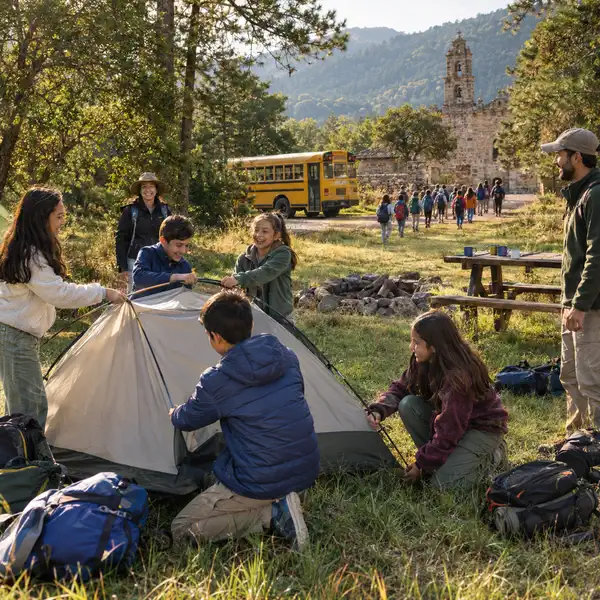
Choosing between a school camp vs school trip looks like a logistics decision, but it actually defines what students take away from the experience. A traditional school trip usually revolves around a destination, with long bus rides, guided tours and packed schedules. A school camp revolves around the group, with shared living, outdoor challenges and learning that happens while students set up a tent, share a meal or work through a disagreement with a classmate.
For principals, coordinators and parents in Mexico, this decision comes up every school year. Taking a class to a museum and an archaeological site checks a clear cultural box, while getting them out into nature for a few days builds independence, teamwork and confidence. The best choice depends on the students’ ages, your budget and what you want the outing to accomplish.
The sections below break down the real differences between the two formats, with a side-by-side comparison table, a practical example and a checklist to help you decide.
A traditional school trip is an organized outing that combines transportation, lodging, meals and visits to places of cultural, historical or scientific interest. According to the definition used in the travel industry, these packages usually include transfers, excursions, recreational activities and insurance, and they serve as an end-of-year celebration or a complement to what students learned in class, as Hosteltur explains.
In Mexico, the most common examples are tours around Mexico City to see museums and the historic downtown, visits to archaeological sites like Teotihuacan, and end-of-year trips to beach destinations. The value of the trip is in the destination, and the group takes part as an audience for an itinerary that was planned ahead of time.
A school camp is a community living experience that takes place in one location, almost always surrounded by nature, and uses group living as an educational tool. The government of Buenos Aires, for example, runs short and long camps for elementary and middle school students, and counts those of four to five days as long. A study published in the journal Retos concludes that an educational camp is a great setting for building social skills like communication and assertiveness.
In the State of Mexico, Camper Club Malinalco is an example of this model: a 9-hectare (about 22-acre) property, 90 minutes from Santa Fe, designed for school camps where lodging, activities and gathering spaces are all in one place.
The table below sums up the seven areas where the two formats differ most. The values are general guidelines, since every school can adapt the program to its group.
| Aspect | Traditional School Trip | School Camp |
|---|---|---|
| 1. Goal | See a destination, museum or historic site. | Build social and life skills. |
| 2. Main focus | The destination and the itinerary. | The group and the shared experience. |
| 3. Length and pace | Constant movement and long bus rides. | One location, two to five days. |
| 4. Setting | Cities, museums and tourist areas. | Nature and open spaces. |
| 5. Student's role | Observer following a set route. | Active participant who makes decisions. |
| 6. Group living and independence | Constant supervision, limited independence. | Shared routines and growing independence. |
| 7. Logistics and cost | Multiple vendors and variable cost. | One location and a more predictable budget. |
A school trip aims to help students see a place and connect classroom content to the real world. A school camp aims to build life skills, like cooperating, communicating and taking responsibility. Neither one is better across the board, but each meets a different need at school.
On a trip, the star is the destination and the guide who leads it, whether that's a museum, a historic site or a city. At camp, the star is the group, because students cook, build, organize and solve problems in teams. That flip in roles completely changes what students remember afterward.
Trips are usually defined by movement, with long rides between one stop and the next. Starting from Mexico City, a lot of the itinerary gets eaten up by highway time and waiting in lines. A camp, on the other hand, stays in one place, which frees up time for activities, downtime and group reflection.
A school trip makes the most of urban, cultural or tourist settings. A school camp relies on open spaces, where movement and team games are a natural part of the program. Having sports facilities on the same property lets you pack sports, physical challenges and group activities into one place without any travel time.
On a trip, students watch, listen and take notes, and how much they can participate is limited by the time at each stop. At camp, students act and make decisions, from how they organize their team to how they take on a shared challenge. That hands-on involvement is why many schools use camp at the start of the school year to bring new groups together.
On a traditional trip, supervision is constant and there are few shared spaces, usually just the bus and the hotel. At camp there are shared routines, team chores and gathering spots, like a clubhouse, where the group eats, talks and wraps up the day with an activity. That ongoing time together gives students more chances to practice independence in a safe setting.
A trip means coordinating transportation, tickets, lodging and meals on the road, with multiple vendors and multiple things that can go wrong. A camp puts almost everything in one place, which makes the budget more predictable and the planning easier for teachers. The final cost always depends on the length of the stay, the number of students and the services included.
To see how an outing like this is set up for school groups, the page on school camps at Camper Club Malinalco lays out the format and the available spaces.
The choice between a school camp vs school trip gets clearer once you look at the goal of each outing and where it falls in the school year.
A trip works best when the goal is specific and tied to the curriculum, like reinforcing history with a visit to an archaeological site or science with a tour of an interactive museum. It's also the best option when the content only exists in one specific place and can't be recreated anywhere else.
Camp is the right pick when you're looking for group bonding, social-emotional growth, leadership or an end-of-year experience with real educational value. It's especially helpful at the start of the school year, when classes get shuffled and students need to get to know each other outside the classroom.
Some schools get the best of both worlds with a two- or three-day camp that includes a cultural visit nearby. A group staying in Malinalco, for example, can add a tour of the town's archaeological site and still keep the evening bonding and team activities at camp. For groups that prefer a more flexible setup, there's also the option of a group vacation rental with private spaces.
A school in Mexico City with four fifth-grade classes wants to help students bond at the start of the year. A museum visit covers content, but the kids head back the same day to the same classroom routines and the same cliques. Two nights at a camp in the State of Mexico, an hour and a half from the city, mixes all four classes into new teams, with shared chores and challenges that call for working things out together.
When they get back, teachers find a group that knows each other better and has already practiced dividing up responsibilities. The museum can wait for later in the year, with a clear academic goal. This scenario shows how school camp vs school trip isn't an either-or choice, but a series of decisions based on where you are in the school year.
The main difference is the purpose. A school trip is built around a destination and its stops, while a school camp is built around group living and outdoor activities. On a trip, students watch and tour. At camp, they take part, make decisions and work together over several days in one place.
It depends on the goal. If you want to reinforce history, science or art, a school trip to museums or archaeological sites works well. If you want bonding, independence and teamwork, a school camp usually delivers better results, as long as it has trained staff and activities suited to the group's age.
There's no single standard, but it's typically between two and five days. Educational references like those from Buenos Aires count camps of four to five days as long. For a first camp, one or two nights is a reasonable format that you can extend in future school years.
Yes. Activities can be designed to reinforce curriculum topics like natural science, geography, social-emotional learning or physical education. The key is to agree on the goals with the camp before the outing, so every activity has a purpose and a reflection wrap-up at the end.
The State of Mexico has options a short drive from the capital. Camper Club Malinalco, for example, is 90 minutes from Santa Fe and has 9 hectares (about 22 acres) for hosting school groups, with lodging, activities and common areas all in one place. It's a good idea to request information or visit the site before booking.
In the school camp vs school trip debate, there's no clear winner, because each format does a different job. A trip brings students closer to places and content they'd rarely get to see in the classroom, and a camp gives them room to live together, make decisions and grow as a group. Defining the goal before choosing the format helps you avoid disappointment and makes it easier to justify the outing to families and administrators.
For schools in Mexico City and the State of Mexico looking for a natural setting close to home with the whole program in one place, Camper Club Malinalco offers facilities built for school groups. Request information or schedule a visit through the contact page and put together a proposal tailored to your group.

